

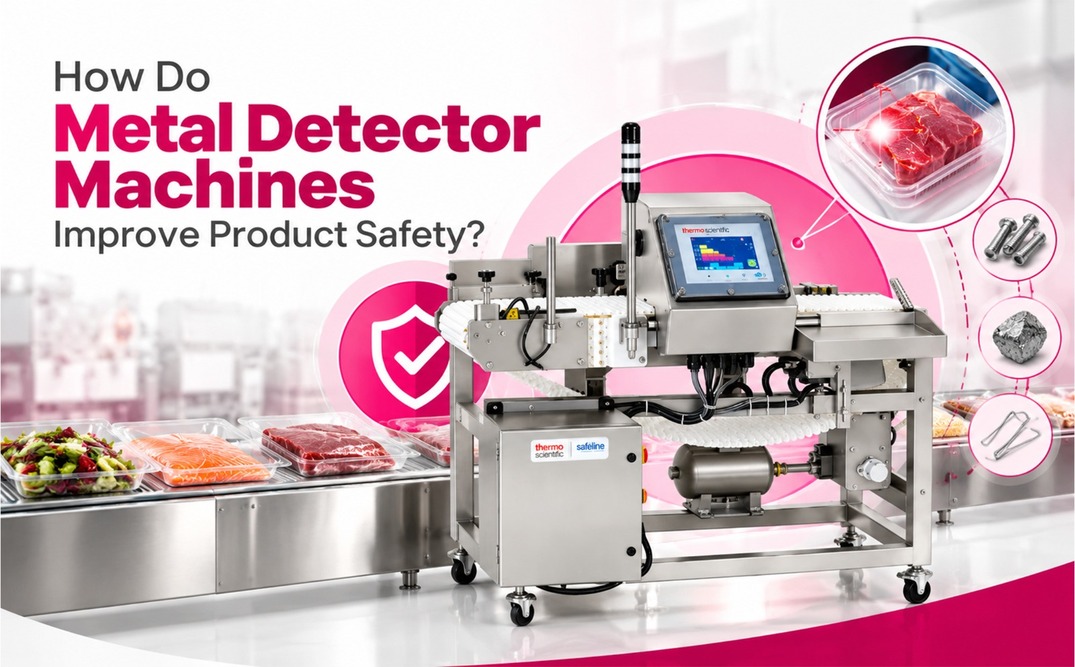
What happens when a tiny metal fragment gets into a product during production? It may be difficult to notice during a normal visual check, but it can create serious quality concerns later. This is why many production lines use additional inspection methods to check products before they move further.
A metal detector machine in Dubai can help identify unwanted metal contaminants during different stages of production. These machines provide an additional check during production. They can support product quality and safer operations across food processing, packaging, and other manufacturing areas.
What is a Metal Detector Machine?
A metal detector is an inspection system designed to identify metal particles in products during processing or packaging. Systems can detect ferrous, non-ferrous, and stainless-steel contaminants depending on the application. The machine is generally installed at a suitable point on the production line and allows products to pass through the detection area. If unwanted metal is detected, the affected product can be separated from the production flow.
Key Features
Every production setup has different needs. The metal detector should suit the product, package type, and working conditions of the production line.
Include:
-
High detection sensitivity - Helps identify small metal contaminants during inspection.
-
Digital signal processing - Supports accurate detection and helps handle production-line conditions.
-
Noise filtering - Helps reduce interference that could affect detection performance.
-
Product phase tracking - Helps the system adapt to different product characteristics.
-
Different aperture sizes - Allows the equipment to suit products of varying dimensions.
-
Easy operation - Clear controls can make routine inspection easier for production staff.
-
Low maintenance needs - A suitable machine can support dependable operation with regular service.
Benefits of Using Metal Detection
Metal detection helps keep production checks consistent by identifying unwanted metal contaminants before products move forward. This can support product quality and reduce the risk of contaminated items reaching the next stage.
A metal detector can help manufacturers:
-
Detect unwanted metal particles before products reach customers
-
Improve food safety and quality control
-
Reduce the possibility of contaminated products entering distribution
-
Support compliance with applicable food safety requirements
-
Reduce product waste and unnecessary rework
-
Maintain more consistent inspection across production batches
-
Add an extra quality-control point to automated packaging lines
Where Are Metal Detectors Used?
Metal detectors are useful in many production areas. Their application can vary depending on the product, process, and working environment. They can be used for both packaged and unpackaged products. They are also suitable for different production stages where checking for metal contamination is required.
Common applications include:
-
Food and beverage: Detecting small metal pieces or fragments within baked goods, dairy products, meat, and packaged snacks.
-
Powders and loose products: Suitable systems can inspect products before or during packaging.
-
Textile and garbage: Detecting needle pieces or other metal fragments in fabrics and clothing.
-
Plastic and rubber: Checking raw materials or finished products for metal contamination before moulding or packaging.
-
Pharmaceutical production: Can be used where contamination control is an important part of production.
-
Packaging lines: Metal detection can be integrated with other inspection equipment and packaging machinery.
Check before choosing
Metal detection can be an important part of quality control across different production environments. The machine should match the product, packaging type, production speed, and inspection requirements. Businesses should also consider installation space, cleaning needs, maintenance, and compatibility with the existing production line before choosing a metal detector machine in Dubai. The production setup and inspection needs help in choosing suitable equipment. It can support regular checks, smooth operation, and consistent product quality. A well-matched system can help identify unwanted metal contaminants before products move further through the process.
 Categories
 Our Brands